How to Choose an SEO Agency in London
A practical checklist for businesses choosing ongoing SEO support
Choosing an SEO provider is difficult because proposals often promise the same outcomes using very different methods. One supplier may focus on rankings, another on traffic growth, and another on technical fixes. For an established London business, the more useful starting question is: “What will this agency actually improve, how will they decide priorities, and how will we judge whether it is helping?”
Good SEO is not a single activity. It may include fixing technical barriers, clarifying service pages, improving internal linking, reviewing search intent and strengthening off-site visibility where appropriate. The right mix depends on the website, competitive market and commercial objective. Before signing an ongoing agreement, ask the questions below.
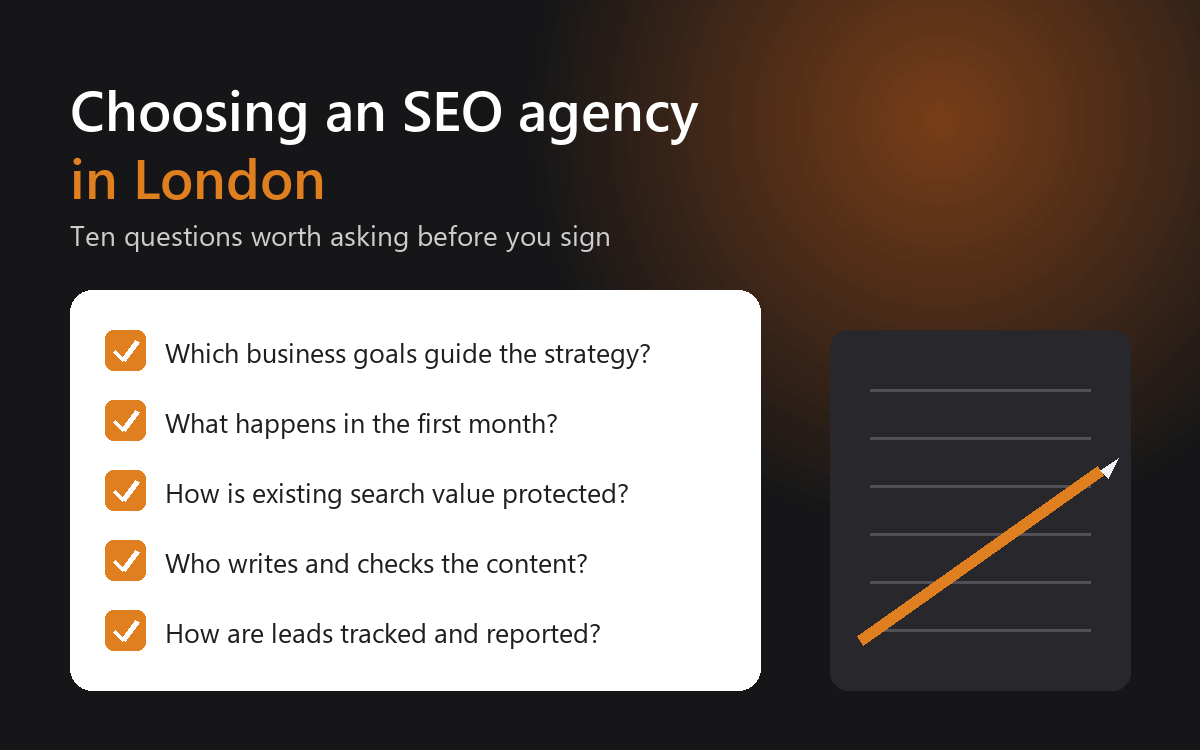
1. What business goals will guide the strategy?
An enquiry-led company should not judge its entire campaign by generic traffic alone. Ask how the agency identifies valuable search phrases, which services take priority and how qualified leads will be measured. A legal practice in Westminster, a manufacturer serving Greater London and a specialist retailer have very different customer journeys.
2. What happens during the first month?
Ask for the initial review scope: Search Console, GA4, indexing, core pages, competitor positioning, internal links, conversion forms and mobile usability. A good provider should explain which items are urgent, which need more evidence and which are unlikely to matter commercially. Avoid proposals that begin with publishing large numbers of near-identical pages before understanding the existing website.
Our Free SEO Audit offers a starting conversation about visibility, website structure and potential opportunities; any deeper implementation is scoped separately.
3. Will the agency preserve your existing search value?
If your site has established URLs, impressions and backlinks, careless rewrites or redirects can undermine that work. Ask how existing pages will be mapped before changes, how 301 redirects will be selected and when a 404 or 410 is justified. Request a clear record of new and retired URLs, along with post-launch checks for broken links, indexing and canonical problems.
4. Who writes the content, and how do they verify claims?
Look at examples of service pages and articles, not just the number of words promised. Can they explain what your business actually does? Are the FAQs useful or merely a sentence repeated across locations? Will they insert accurate contextual links and avoid invented offices, reviews, testimonials and client results? Ask who signs off factual statements before publication.
Relevant Content Marketing should support genuine customer questions and service decisions, rather than fill a publishing quota.
5. How are leads and reporting handled?
A monthly report should help you understand progress, not simply display attractive graphs. Ask how the agency checks GA4 setup, Search Console trends, form delivery, phone links and successful lead events. Clarify whether the report distinguishes qualified enquiries from spam or unrelated messages. If Analytics says “no data”, the first task is to verify collection rather than inventing performance conclusions.
6. What exactly is included in the monthly fee?
Check how many hours or deliverables are allocated, who implements website changes, whether hosting or development is included, and how additional work is priced. Ongoing SEO is a managed process, not a one-off guarantee. Be wary of packages promising hundreds of links or immediate first-place positions without explaining quality or risk.
7. What happens if you want to leave?
You should understand access, ownership and notice terms before work begins. Confirm that you retain appropriate control of your domain, website, analytics, Search Console and original content. Ask how an agency documents redirects, technical work and completed deliverables so you can continue operating the website independently if your circumstances change.
8. Does the agency understand your market without inventing a local office?
Serving London businesses does not require an agency to pretend it occupies an office in every borough. More relevant is whether the team understands the different search demands across central business districts, local-service markets, professional services and ecommerce. Look for grounded knowledge and accurate business details rather than a collection of cloned town pages.
Our Areas We Cover page outlines the London markets we support without suggesting a separate staffed office in each location.
9. Can they explain what they will not promise?
No credible agency controls Google rankings or future AI-generated answers. Good providers should state what they can implement, what they can measure and what remains outside their control. This does not make the strategy weak; it makes the commercial expectations more realistic.
10. Will the relationship be useful six months from now?
Ask how priorities change as evidence develops. If a page begins attracting qualified enquiries, the next step might be better conversion paths. If a technical fix restores indexing, content improvements may become more worthwhile. The right agency should adapt rather than simply repeat an identical monthly checklist.
Questions business owners often ask
Should I choose an SEO agency based only on its own rankings?
An agency’s search visibility can provide context, but it is not proof that it can deliver results for your business. Assess the proposed process, relevant experience, transparency, reporting and ability to understand your market.
Are low-cost SEO packages always a bad idea?
Not automatically. The key is whether the scope matches your needs. A small defined task can be worthwhile; a complex, competitive programme needs enough time for diagnosis, implementation and measurement.
What should I bring to an initial SEO discussion?
Your website URL, main services, desired customer locations, examples of important competitors and any existing Search Console or Analytics information. Clear business priorities make the initial advice more useful.
Want to discuss a practical campaign rather than vague promises? Contact Us and explain which services or types of enquiries you want to grow.